
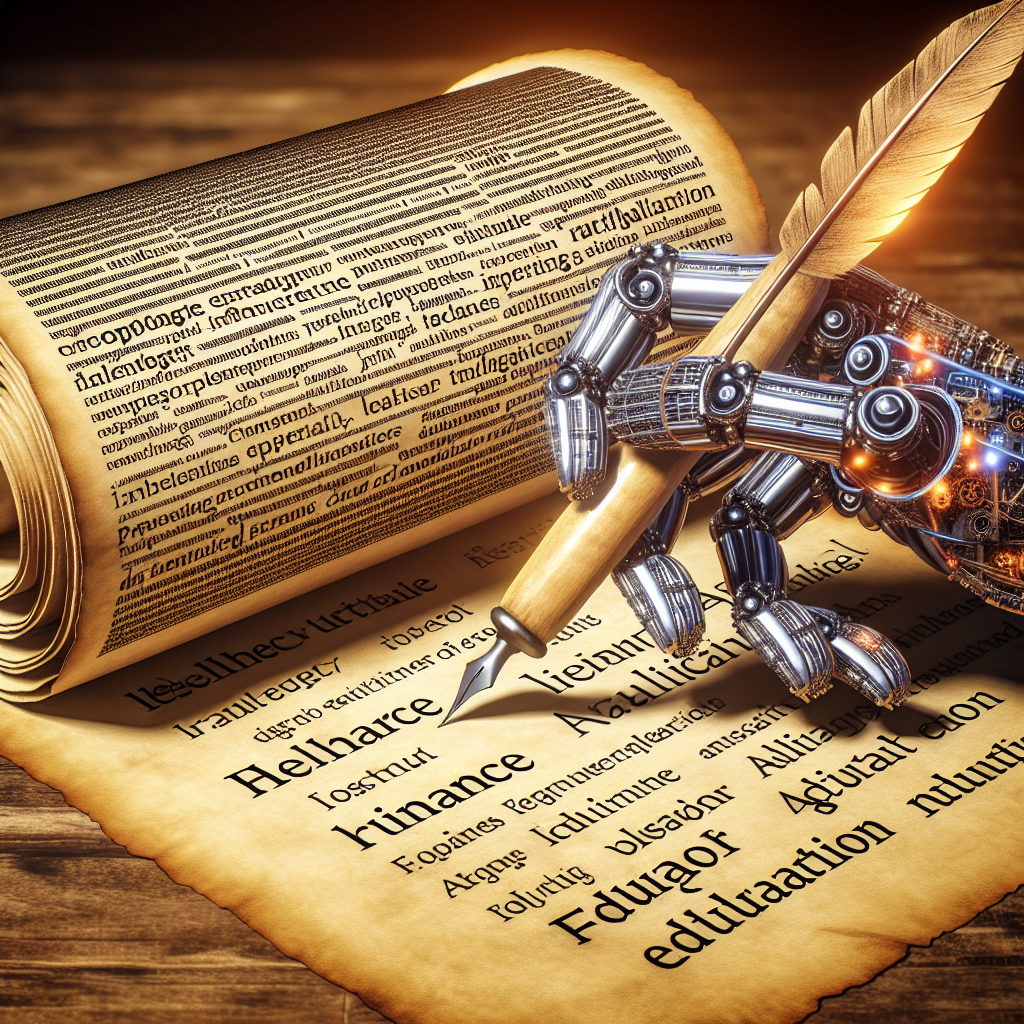

The future of work is being rewritten before our eyes. Across industries, automation powered by advanced AI is transforming entire sectors by replacing repetitive, process-driven tasks with intelligent systems that work faster, more accurately, and around the clock. The impact is already tangible—jobs that once required teams of experts are now being managed by algorithms capable of processing thousands of documents or transactions in a blink.
Legal & Compliance: When Machines Master the Law
Imagine a world where contract review, legal research, and compliance checks happen in minutes instead of hours. Advanced legal platforms can now sift through mountains of legal documents, evaluating complex clauses and ensuring strict adherence to compliance requirements with near-perfect precision. Tasks that once demanded years of training and substantial manpower are now automated, prompting legal professionals to rethink their roles. The rapid adoption of these solutions poses a pivotal question: Will law firms continue to hire at the same pace, or must a new breed of legal professionals learn to work alongside AI?
Accounting & Finance: Crunching Numbers Without a Coffee Break
The accounting world is undergoing a dramatic overhaul as AI takes over spreadsheet-centric tasks. Software systems can detect fraudulent patterns, reconcile intricate financial data, and generate detailed financial reports faster than ever before. With AI handling routine functions—from tax filing to audit procedures—the traditional role of the accountant is evolving. Organizations are beginning to see the benefits of reallocating human talents toward strategic financial decision-making and higher-level data analysis, rather than the monotonous task of number crunching.
Healthcare Administration: Efficiency with a Costly Trade-Off
In the healthcare sector, while the quality of patient care remains paramount, the administrative backbone is suffering one of the most significant overhauls. AI systems are rapidly taking over medical coding, insurance claims processing, and appointment scheduling. Although these tools dramatically reduce processing times and cutting administrative costs, they also threaten to displace millions of workers who have long supported the essential functions of healthcare facilities. As efficiency climbs, the balance between technology and employment continues to be a delicate issue.
Customer Support: The Future of Service Interactions
The transformation in customer service is perhaps one of the most visible. Today’s sophisticated chatbots and voice assistants are capable of handling the lion’s share of routine inquiries, leaving little room for traditional call center roles. With AI systems now addressing vast numbers of customer interactions simultaneously, the need for human-operated support centers is rapidly diminishing. The challenge for businesses is clear: adapt to integrate these powerful tools without losing the human touch in complex or sensitive issues.
Content Creation & Data Management: A New Era of Digital Productivity
Even fields that we once assumed could only be driven by human creativity are not immune. AI-powered tools are now capable of generating compelling articles, marketing copy, and even intricate data analyses. When deadlines loom and budgets tighten, organizations are increasingly turning to these systems to produce high-quality content at a fraction of the cost and time traditionally required. However, as the technology matures and continuously improves, the roles of writers, editors, and data analysts are adapting—a shift that emphasizes strategic oversight and creative input rather than routine production.
The underlying theme across all these shifts is clear: the integration of AI is not a matter of “if” but “when.” Some industries are already seeing the benefits of embracing this change, while others are facing a necessary—and sometimes painful—transformation. For those whose skills are aligned with repetitive tasks, the choice is stark: evolve and learn to work alongside AI, or risk being left behind in a rapidly automated world.
This ongoing revolution does not herald the annihilation of work but the emergence of new roles where human ingenuity complements machine efficiency. As history has shown, technology evolves and reshapes the fabric of our economy. The challenge and opportunity for the next generation lie in harnessing these tools to unlock creativity, strategic insight, and value—ushering in a future where machines handle the mundane, while humans direct the extraordinary.


